



About C3
Program Overview
The Colorado Circular Communities (C3) Enterprise is a statewide program dedicated to supporting Colorado’s communities, businesses, nonprofits, schools, institutions of higher learning, and tribes to advance the state’s transition to a circular economy. We provide financial and technical assistance to enhance circularity across the state, and help organizations achieve their waste aversion and diversion goals.
The Enterprise is funded through user fees at Colorado landfills, is administered by C3 program staff within the Colorado Department of Public Health and Environment (CDPHE), and is guided by the C3 Board of Directors. For information regarding the C3 Board of Directors, including their meeting agendas and minutes, please visit the C3 Board of Directors webpage.
Watch the Introduction to C3 Webinar below to learn more. This session provides an in-depth look at the development of the C3 program, how it differs from previous Recycling Resources Economic Opportunity (RREO) and Front Range Waste Diversion (FWRD) programs, and the introduction of the first strategic plan.
Covering Colorado
C3 has five satellite connections to support circularity efforts in regions outside the Front Range.
Satellite partners serve as thought partners, collaborators, and circular economy advocates in the regions they serve. They support communities in understanding C3 and how to successfully access available resources, support grant applicants, and help develop projects for grants and Strategic Technical Expertise for the Public Sector (STEPS). Their local knowledge and expertise help ensure that projects are responsive to the people and places they are intended to serve.
To explore grant or project opportunities and brainstorm creative ways to support your community with a circularity thought partner, feel free to reach out to your region’s satellite contact.
Southeast Region - Ally Palmer; c3allyp@gmail.com
Southwest Region - Marianne Mate; marianne@circularoutreach.com
Western Slope Region - Mike Ritter; mritter@gjincubator.org
Northwest Region - Caitlin Farkas; caitlin.farkas@westernresilience.org
Northeast Region - Susan Renaud; susan@circularoutreach.com
If you have questions or concerns about a “shovel-ready” C3 grant or project, you may contact the team directly through the C3 online funding inquiry form.
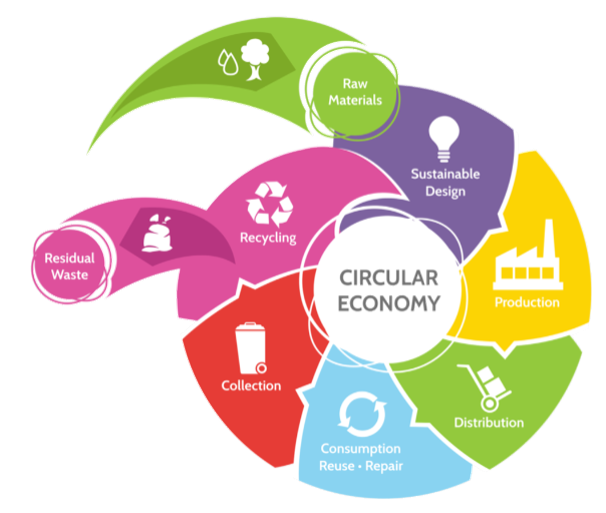
Source: Circular Colorado
What is a Circular Economy?
A circular economy recognizes that every by-product and material has value. It uses a systems-focused approach and involves industrial processes and economic activities that:
Are restorative or regenerative by design;
Enable resources used in industrial processes and economic activities to maintain their highest values for as long as possible; and
Aim to eliminate waste through the superior design of materials, products, and systems, including business models.
Circularity strategies include designing for durability, reuse, remanufacturing, repairing, recovering, and recycling, while prioritizing renewable inputs, maximizing product usage and value, and supporting a more sustainable food system.

History & State Statute
On May 8, 2024, HB24-1449 established the Colorado Circular Communities (C3) Enterprise. On July 1, 2024, C3 officially replaced the Recycling Resources Economic Opportunity (RREO) program and the Front Range Waste Diversion (FRWD) Enterprise program. All open contracts executed under the RREO and FRWD programs were transferred to the C3 program. By consolidating these initiatives, C3 modernizes pollution prevention efforts across the state, streamlines operations, and provides greater flexibility for funding and technical assistance for all of Colorado.

Strategic Plan & Annual Reports
The C3 strategic plan outlines the program’s priorities, objectives, and detailed action steps for advancing circularity across Colorado. The CY2025-CY2029 plan was approved by the C3 Board of Directors in November 2024 and includes the following three strategic goals:
Increase participation in the State’s circular economy;
Reduce material consumption;
Increase material capture for in-state marketability.
Annual reports provide insights into the program’s progress, showcase successes, and highlight the impact of funded projects and initiatives. These reports will serve as a valuable resource for stakeholders to understand how C3 is driving sustainability statewide. C3 board materials including annual reports are shared on the board webpage.
C3 staff presented the Strategic Plan Progress Report to the Board at the Sept. 10, 2026, meeting. The report, available online on the C3 and Board websites, includes a complete list of C3 projects.